 Download case study (.md)
 Service-Agreement.pdf
Sender initiates
Request enters the system
- To
- sign@docsbyair.com
- CC
- jane@example.com
- Subject
- Service Agreement
- Attachment
- Service-Agreement.pdf
Product Designer
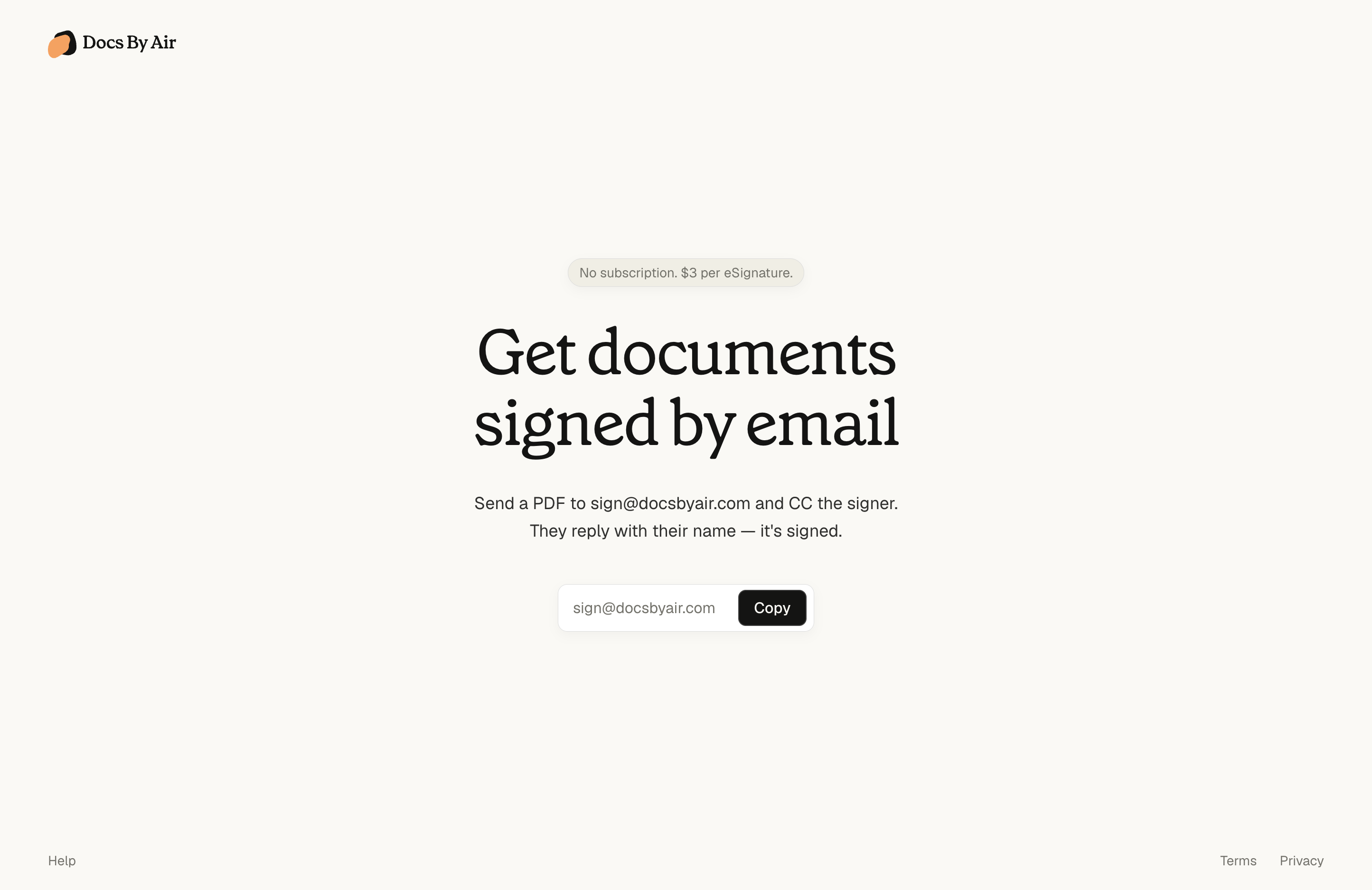
Docsbyair is a document execution system that completes signing entirely within an email thread.
Docsbyair began as an exploration into using email as an execution layer rather than a communication tool.
Early versions followed a familiar pattern, with flexible inputs, conversational flows, and broad capability. It worked, but it didn’t hold up as a product. The system relied too heavily on interpretation, and the outcomes weren’t reliable enough for execution.
Prioritizing reliability over flexibility shifted the direction entirely. Instead of asking what AI could do in email, the focus became what workflows already existed there that required deterministic outcomes.
Documents stood out.
Email is where documents are sent, reviewed, and approved. The behavior already exists, but execution typically happens outside the thread.
The opportunity wasn’t to introduce something new. It was to complete what was already happening.
The first versions of the signing flow were overdesigned.
There were instructions, confirmations, structured replies, and even required legal statements the signer had to copy and paste. It was technically correct, but introduced unnecessary friction.
The breakthrough came from recognizing what was already present.
A reply with a name, in the context of a request, tied to a document, inside a thread functions as a signature.
Nothing else needed to be added. No links. No dashboards. No signing pages.
Just a reply.
Sender initiates
System instruction
Signer reply
Jane Elizabeth Doe
Execution confirmation
Fulfillment
That simplification exposed something more fundamental.
The interface wasn’t the email.
It was the address.
Action
Transport
Execution System
sign@docsbyair.com isn’t just where the request is sent. It defines the action itself. The intent exists before the email is even written.
That removes the need for almost everything else.
No subject or body requirements. No structured inputs. No instructions beyond the action itself.
Attach the document. CC the signer. Send.
The rest happens.
Every decision after that followed the same pattern.
Anything that introduced ambiguity was removed. Anything that required interpretation was reduced.
The system became entirely deterministic.
A request is valid or it isn’t.
A reply is accepted or it isn’t.
A document is executed or it isn’t.
The entire flow collapses into a single sequence:
There are no alternative paths.
That’s the point.
By the time the system worked, it didn’t require AI.
All critical behavior was handled through structure, including thread integrity, validation, and explicit state transitions.
AI was introduced only where deterministic logic breaks down.
A signature relies on a person identifying themselves. Most replies contain a name, but not always in a way that can be strictly validated.
AI is used to evaluate plausibility by classifying whether a reply functions as a name and deferring to the initiator when uncertain.
It doesn’t determine identity.
It reinforces the system where strict rules are insufficient.
Docsbyair isn’t a signing platform.
It’s an execution system.
There’s no interface to open. No dashboard to manage. No place to go.
You send something into it, and it completes the action. The thread is the record. The document is the source of truth. The reply is the signature.
Everything else is removed.
Most software adds layers to support more capability. Docsbyair moves in the opposite direction by collapsing those layers so the intent behind an action can pass through without friction.
The result isn’t less capability, but a clearer path from intent to outcome, where the system exists to complete the action rather than mediate it.
Chat answers questions about my portfolio.