×

This case study is shared selectively due to client constraints.

Enter the password to continue.

Brandon Zanders

Product Designer

Tauck 100th

A digital timeline celebrating 100 years of Tauck history, designed as a cross-surface interaction system spanning kiosk, tablet, desktop, and mobile.

Role
Product Designer (Interaction Systems)
Timeline
Jun 2024 – Jan 2025
Platform
Web
Surfaces
Kiosk, tablet, desktop, mobile
Scope
Cross-surface interaction system for a 100-year timeline
Status
Completed (not shipped)

Tauck partnered with Shavrick & Partners to create a digital experience capturing 100 years of company history.

The goal was open-ended: to translate the breadth of Tauck’s legacy into an exploratory system that guests, partners, and employees could navigate.

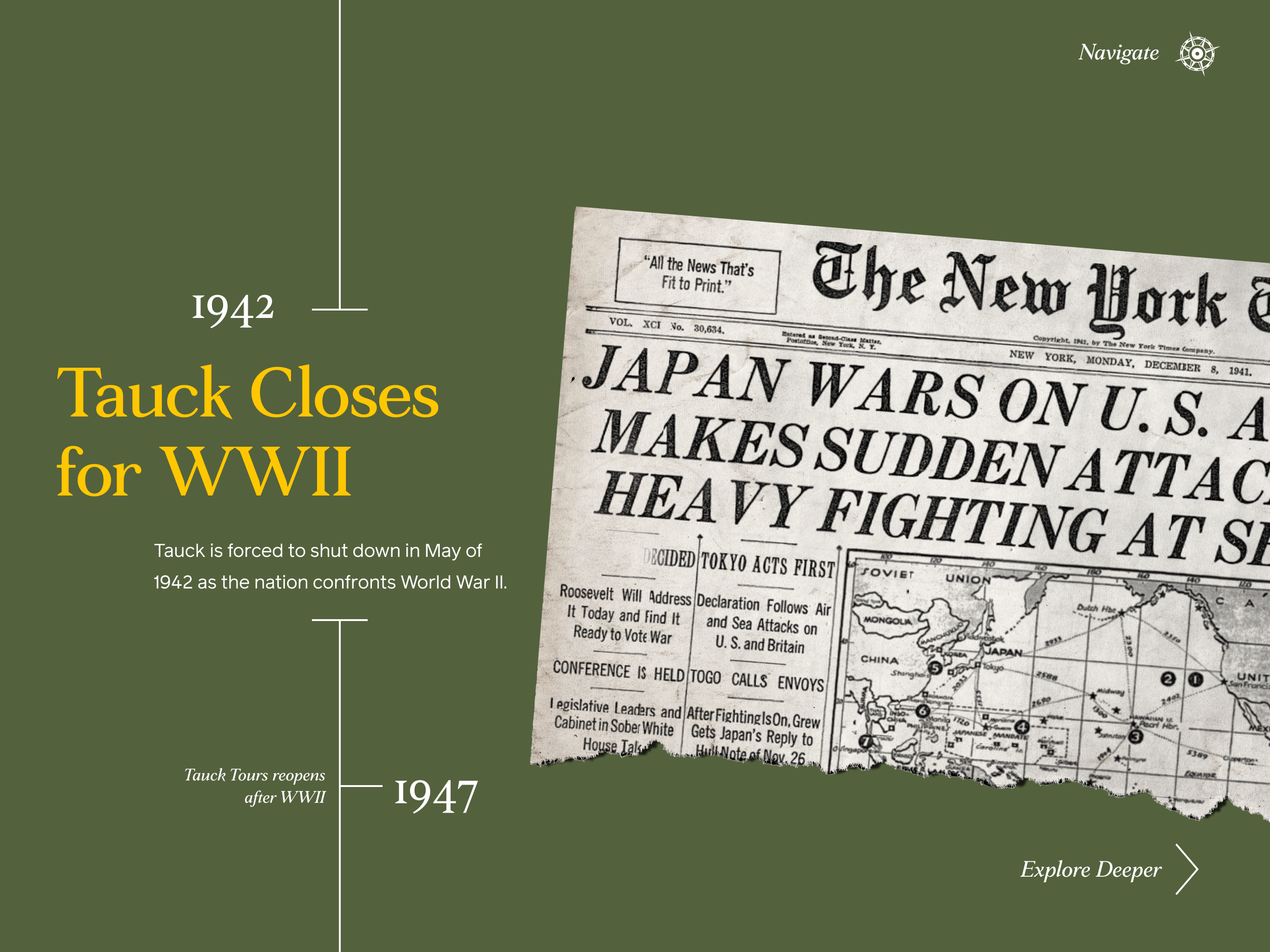
Before I joined, multiple directions were explored to structure the experience. The selected direction, Storytellers, was a vertically scrolling timeline with optional horizontal detours.

Direction
Eras
Maps
Storytellers
Interaction Model
Era-based exploration with distinct visual systems per period.
Geography-first navigation organized by location and thematic pillars.
A scroll-driven vertical timeline with optional horizontal detours for deeper exploration.
Why it works
Rich, contextual storytelling that mimics physical travel ephemera in digital form.
Strong geographic framing and clear thematic messaging.
Intuitive linear flow, one responsive solution across screens, and a modular structure by design.
Constraints
Would require separate desktop and mobile builds and introduced heavy hidden content.
Extremely time and budget intensive, with several milestones not mapping cleanly to location.
Lower content density per screen can increase screens/states needed to tell stories.

Eras

Interaction Model

Era-based exploration with distinct visual systems per period.

Why it works

Rich, contextual storytelling that mimics physical travel ephemera in digital form.

Constraints

Would require separate desktop and mobile builds and introduced heavy hidden content.

Maps

Interaction Model

Geography-first navigation organized by location and thematic pillars.

Why it works

Strong geographic framing and clear thematic messaging.

Constraints

Extremely time and budget intensive, with several milestones not mapping cleanly to location.

Storytellers

Interaction Model

A scroll-driven vertical timeline with optional horizontal detours for deeper exploration.

Why it works

Intuitive linear flow, one responsive solution across screens, and a modular structure by design.

Constraints

Lower content density per screen can increase screens/states needed to tell stories.

The experience was initially designed for a kiosk environment, where interaction could be tightly controlled.

This introduced a core uncertainty: how to design an interaction system without a fixed device, input model, or viewport.

I joined at the point where the initial high-fidelity kiosk concept had to extend beyond a single surface.

My first step was a design audit: identifying inconsistencies, interaction dependencies, and structural gaps across early concepts.

From there, I defined the interaction model, motion behavior, and structural rules needed to make the timeline scalable and buildable across surfaces.

These were the core interaction and system challenges that shaped the final experience.

Viewport: interaction timing as a dependency

Motion in the timeline was scroll-driven, with section entry and exit triggering nearly every interaction. This created a dependency: section height directly controlled when and how interactions occurred.

Across viewports, that dependency broke. The same moment would trigger too early, too late, or inconsistently depending on screen size, making behavior unreliable.

Timeline screen showing a story detail
Viewport entry
Viewport midpoint
Viewport exit

Timeline interaction zones

Decision

I defined a viewport system that decoupled interaction timing from a single layout model, using calibrated section heights per device class to normalize behavior.

Outcome

Interaction timing became predictable, ensuring motion and scroll behavior remained consistent regardless of screen size.

Motion: systematizing a creative constraint

Motion was a core part of the creative direction, with the timeline designed as a scroll-driven, highly animated experience.

However, without a defined system, motion became a source of inconsistency. Animations triggered across headlines, artifacts, media, and transitions without shared rules, varying based on direction, entry point, and state. This created tension between expressive motion and predictable behavior, making the system difficult to reason about and scale.

Bi-directional motion system

Decision

I established motion as a system, defining consistent rules for timing, directionality, and state persistence, ensuring predictable behavior while preserving the intent of the creative direction.

Outcome

Motion became consistent and repeatable, reinforcing hierarchy and orientation without introducing variability as the system scaled.

Detours: separating navigation models

The timeline introduced two navigation models: a linear vertical scroll for the main narrative and horizontal detours for deeper exploration.

Initially, both relied on similar gesture inputs, creating conflict. Entering and exiting detours lacked clear boundaries, and interactions that worked in isolation broke when combined, causing disorientation. The system didn't clearly distinguish between navigating the timeline and exploring within it.

Isolated detour interaction

Decision

I redefined detours as isolated interaction spaces with explicit entry and exit states, separating their behavior from the main timeline.

Each model was given distinct interaction rules: vertical scroll governed progression, while horizontal gestures were reserved for exploration within detours.

Outcome

Navigation became predictable and legible, allowing uninterrupted progression through the timeline while detours supported deeper exploration without breaking orientation.

The final system supported four channels, kiosk, tablet, desktop, and mobile.

Interaction behavior remained consistent across surfaces, with motion scaling predictably across hundreds of assets and the system structured to support ongoing content additions without variability.

The experience was delivered to spec and well received by stakeholders. It was ultimately parked due to internal content decisions, not issues with the experience itself.

The most significant constraint was not design, but scope. Introducing a multi-channel system late created complexity that compounded over time, reinforcing the importance of defining interaction models and platform assumptions early.